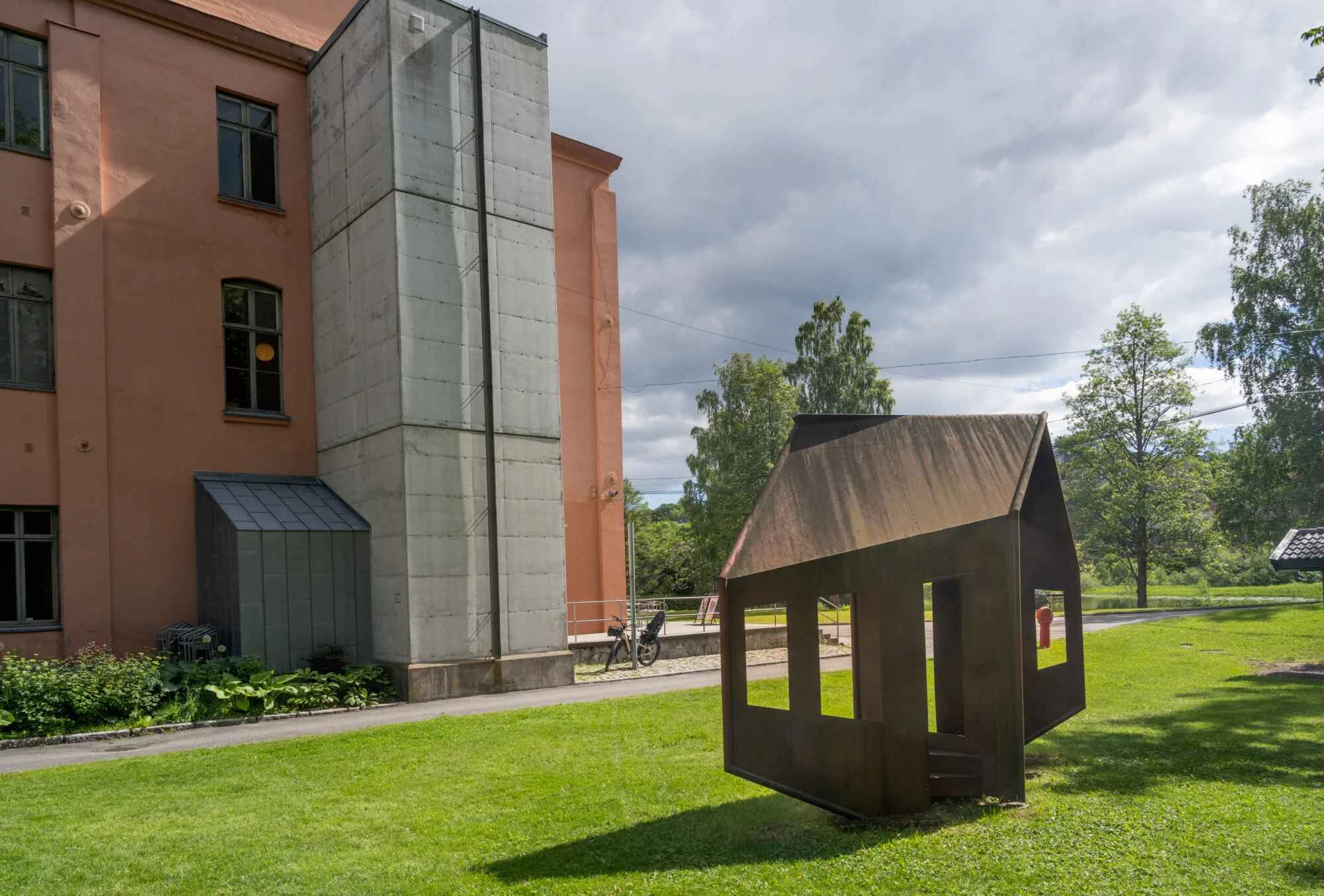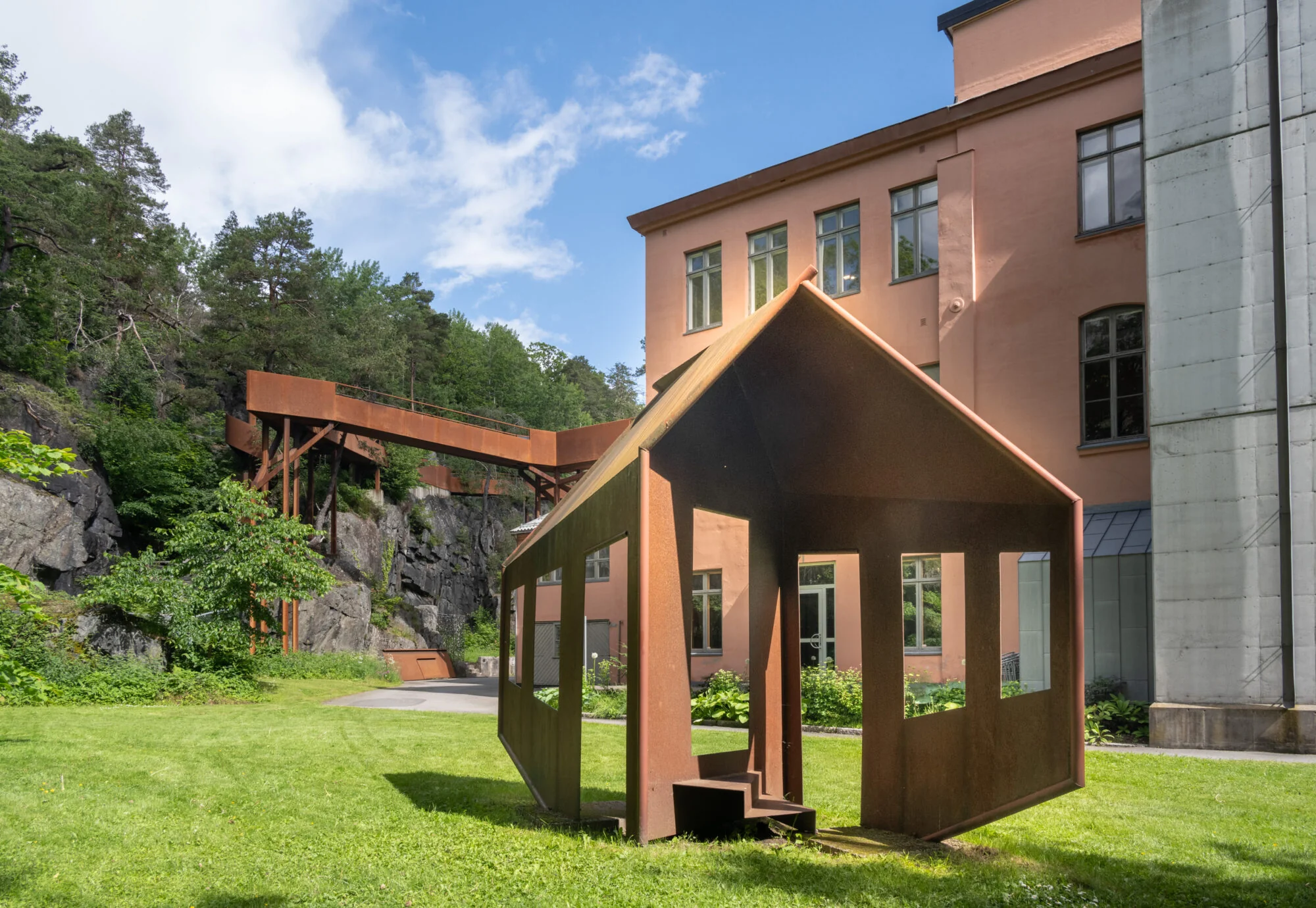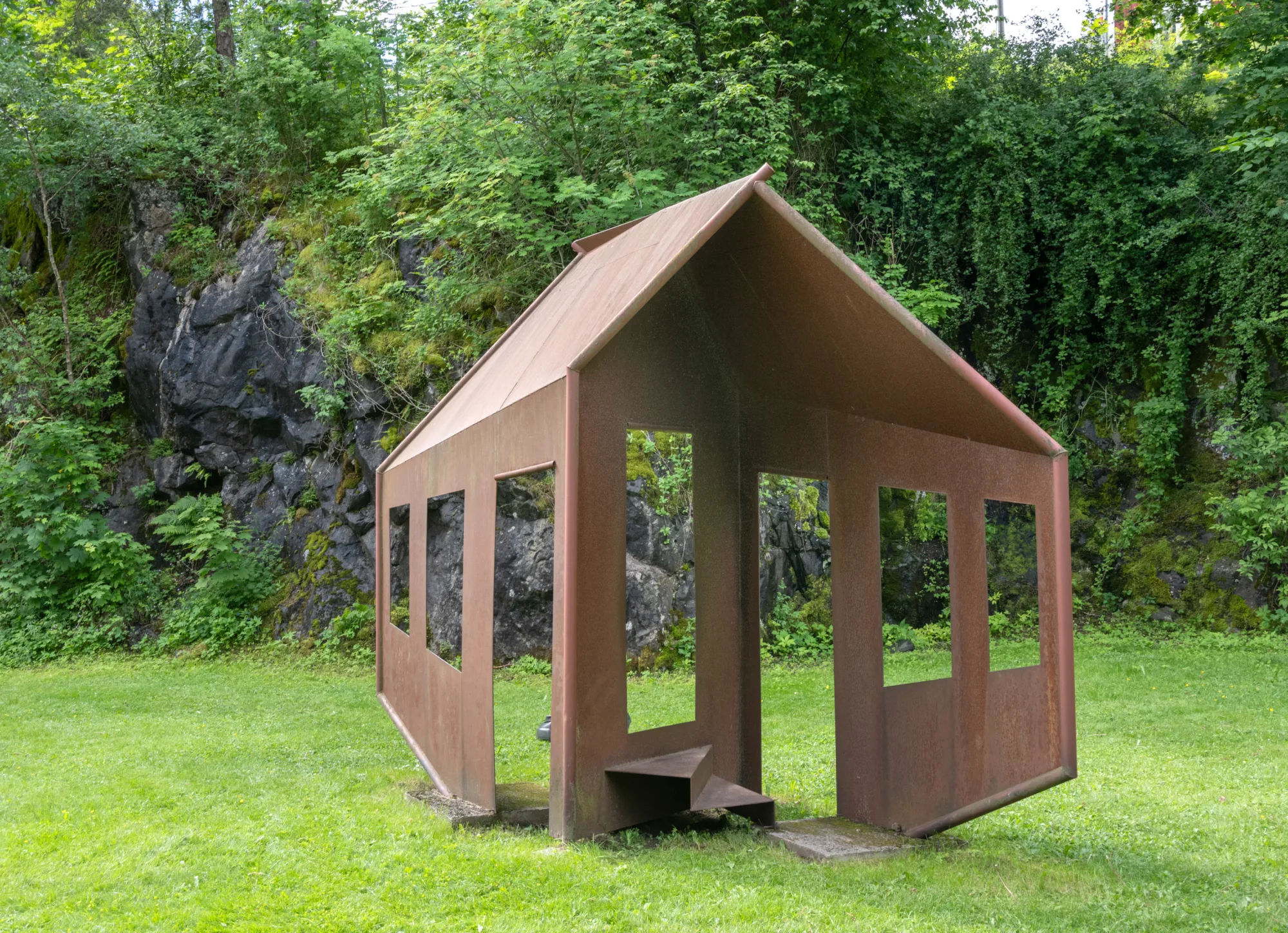
Hvordan går det, takk skal du ha (1987) by Jon Gundersen
Hvordan går det, takk bare bra (How are you? Thanks, just fine) is a sculpture in Corten steel depicting a house in a simple, schematic form. The work consists of a stylised house volume reduced to its most basic lines. While the form appears as a drawing, it is also physical and spatial. Visitors can walk through the sculpture, spend time inside it and experience how the form changes when viewed from different angles.
In Gundersen’s house, the building is reduced to a simple outline. The work lacks walls, windows and doors, yet is immediately perceived as a house. It can be experienced as a drawing in the landscape, but also as a space that visitors can enter and move through. For many years, the work was known as Hus (House) at Bomuldsfabriken Kunsthall. Shortly before Jon Gundersen’s death in 2025, documentation from the artist’s own archive emerged linking the work to the title Hvordan går det, takk bare bra. The title adds a human dimension to the work: where the form is simple and quiet, the title points towards an everyday conversation. The juxtaposition of the sober house form and the spoken title is characteristic of Gundersen’s artistic practice, in which simple objects are often placed in unexpected contexts.
The sculpture has been part of Bomuldsfabriken’s history since the establishment of the art hall in the 1990s. The visual artist Leonard Rickhard (1945–2024), who was a central driving force behind the establishment of Bomuldsfabriken and the development of the art collection, contacted several of his artist colleagues at the time and asked to borrow works for the new exhibition venue. Gundersen’s sculpture remained, and over more than three decades it has become a familiar and cherished landmark for both visitors and staff. In 2025, the work was incorporated into Bomuldsfabriken’s collection. In Gruvene skulpturpark, the sculpture stands at the transition between the art hall and the mining area.
Jon Gundersen (1942–2025) was one of Norway’s most prominent sculptors. Throughout a long artistic career, he worked with sculpture, objects and installations in which recognisable forms and everyday things were often placed in new contexts. With humour, precision and a love of simplicity, he investigated how meanings arise and change when familiar forms are moved out of their usual context.